Solano County Public records include a wide range of official filings created during legal proceedings within the county court system. These records cover criminal, civil, family, and probate cases, giving users clear insight into legal actions and outcomes. Public records Solano County systems allow users to review case details such as filings, hearing dates, and judgments. Many records remain open for public viewing, which supports transparency and accountability. This makes document access easier for those seeking reliable legal information for research, verification, or personal reference.
A Solano County Public records search process allows users to locate and retrieve case information through online databases or courthouse services. Users can search by name, case number, or filing date to find relevant records quickly. Document access tools provide summaries, case status updates, and sometimes full records. For certified or detailed files, users can request copies through the clerk’s office. This structured record retrieval system helps users save time and find accurate legal data without confusion.
What Counts as Public Court Records in Solano County
Solano County court records include all legal documents created and filed during court proceedings within the county’s judicial system. These records form an official record of each case and help track legal actions from start to finish. Solano County court records include all legal documents created and filed during court proceedings within the county’s judicial system. These records form an official record of each case and help track legal actions from start to finish. They may include filings such as complaints, motions, orders, judgments, and court transcripts. These documents are maintained by the court to ensure accuracy, transparency, and proper case management. Access to these records helps individuals, attorneys, and researchers review case history and legal outcomes.
Legal Scope of Court Records
Solano County court records cover legal documents, court filings, docket entries, case records, and official documents submitted during court proceedings. These records apply to criminal, civil, family, and probate cases handled within the county courts. Each document reflects a step in the legal process, such as complaints, motions, or court decisions. Courts maintain these records under state law, which allows public review while protecting sensitive details like sealed or confidential case information when required.
- Filed pleadings such as complaints and motions
- Docket entries that track case activity
- Court orders, rulings, and final judgments
- Hearing and trial-related documents
Record Lifecycle
Every document in Solano County court records follows a structured lifecycle that supports accurate storage and retrieval. The process begins when a filing is submitted to the clerk’s office, where it receives a case number and indexing details. The court system then stores and updates the record as the case progresses. Once processed, the record becomes searchable through court records search Solano tools, allowing users to locate case details through organized databases or in-person systems.
- Filing of initial legal documents
- Indexing with case number and party details
- Ongoing updates during the case
- Public search and retrieval options
Court Records vs Other Public Records
Solano County court records differ from other public records since they originate strictly from court proceedings. These records relate only to cases handled within the judicial system, while other public records come from separate government offices. This distinction helps users avoid confusion during searches and improves accuracy. Court records focus on legal case activity, while non-court records relate to administrative or civic data maintained by different agencies across the county.
- Court records: case filings, judgments, and docket entries
- Non-court records: property records, vital records, business licenses
How to Search Solano County Public Records
Accessing Solano county Public records is essential for residents, attorneys, and researchers who need accurate case information. These records cover criminal, civil, family, probate, and traffic cases maintained by the Solano County Superior Court. Users can search online, visit the courthouse, or request certified copies. The official website ensures secure and up-to-date access: https://solano.courts.ca.gov. Below is a complete step-by-step guide for using the online case search portal, including tips for both beginners and experienced users.
Steps to Search Public Records
The Solano County Court provides a dedicated online URL for accessing court records. This tool allows users to search for cases quickly and efficiently without visiting the courthouse. It supports case number search, name-based search, and filters for filing date or case status. The system displays all public information available, including case details, hearing dates, and document titles.
Steps to Search:
- Open the Online Portal
- Visit the portal https://portal.solano.courts.ca.gov to access the official case search page.
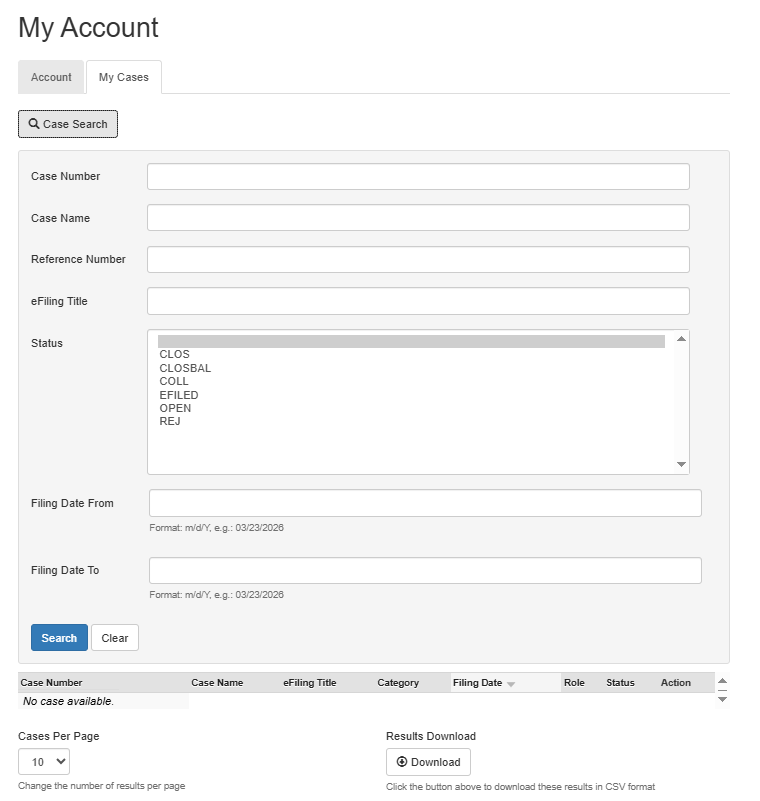
- Navigate to “My Cases” or “Case Search”
- If you have an account, log in and click the My Cases tab.
- For general public searches, click the Case Search button.
- Then you have to login if you already have an account if not then “register” first and then login
- Enter Search Criteria
- Case Number: Enter the exact case number for the most accurate results.
- Case Name: Enter the party or business name if you don’t have a case number.
- Reference Number: Optional field for specific court references.
- eFiling Title: Optional field if you know the title of the filed document.
- Filter by Status
- Choose from options like CLOS (Closed), CLOSBAL, COLL, EFILED, OPEN, REJ to narrow results to open, closed, or rejected cases.
- Set Filing Date Range
- Enter Filing Date From and Filing Date To to find cases filed within a specific period.
- Format: mm/dd/yyyy (e.g., 03/23/2026)
- Search: Click the Search button. The system will display matching cases in a table showing:
- Case Number
- Case Name
- eFiling Title
- Category
- Filing Date
- Role
- Status
- Review and Download the Results
- Scroll through the results and click on a case for more details.
- Select the number of cases per page and click Download to export results in CSV format. This is helpful for offline review or recordkeeping.
In-Person Record Search
For records not available online, visit the courthouse where the case was filed. Court clerks can assist with searches using case numbers, party names, or filing dates. Bring valid photo ID and any applicable fees. In-person visits also allow you to clarify record details directly with court staff. It is recommended to check courthouse hours and access policies before your visit. This method is useful for:
- Older cases not digitized
- Sealed or restricted records
- Reviewing original filings
Requesting Certified Copies
Certified copies are official court documents with the court seal and signature. They are required for legal, financial, or official purposes. Processing times may vary depending on the court and request volume. Ensure all provided information is accurate to avoid delays or rejection of the request.
Steps to Request Certified Copies:
- Identify the document needed (e.g., judgment, order, register of actions).
- Complete a records request form at the courthouse or online.
- Provide case number, party names, and document details.
- Pay applicable fees (commonly around $40 per certified copy).
- Receive the document in person or by mail.
Core Record Categories and Data Fields
Public records Solano County include multiple case categories that reflect different types of legal activity handled by the court system. These records store structured data fields such as case number, party name, filing date, case status, and court division, which help users identify and review specific cases with clarity. Each record type follows a consistent format, making it easier to compare record types, filing classes, and case categories across the system. This structured approach supports efficient searches and accurate case tracking.
Criminal Records
Criminal records form a key part of public records Solano County, covering cases where the state prosecutes an individual for alleged offenses. These records include detailed information about charges, court proceedings, and final outcomes. Users often search these records for legal verification, background checks, or case tracking within the criminal justice system.
- Charges filed against the defendant
- Case number and court division
- Party name of defendant and prosecution
- Filing date and hearing schedule
- Disposition (case outcome such as dismissal or conviction)
- Sentencing details including fines, probation, or jail time
Civil Records
Civil records document disputes between parties, such as contract issues, property claims, or personal injury cases. These case categories do not involve criminal charges but focus on resolving conflicts through legal action. Civil filings follow a structured process, starting with a complaint and moving through motions and final judgments. These record types help users track lawsuits and verify legal claims within the civil court system.
- Initial complaint filing by plaintiff
- Motions and responses submitted during the case
- Case number and involved party names
- Filing date and procedural updates
- Judgment or settlement outcome
Family & Probate
Family and probate records cover sensitive legal matters related to personal relationships and estate management. These filing classes include cases involving divorce, child custody, guardianship, and estate distribution. Courts may limit public visibility for certain details to protect privacy, though general case data often remains available. These records help track legal decisions that affect families and estate handling.
- Divorce filings and marital status changes
- Child custody and support orders
- Guardianship and conservatorship cases
- Probate files related to wills and estates
- Case number, party name, and filing date
Traffic & Infractions
Traffic and infraction records are part of public records Solano County and include non-criminal violations such as speeding or minor offenses. These records are often simpler but still follow a structured format with clear case data. Users may search these records to check citation status or confirm resolution. These case categories provide quick insights into minor legal matters and support efficient record searches.
- Citation number linked to the case
- Party name of the driver
- Violation type and location
- Filing date and hearing details
- Outcome, such as fines or dismissal
Interpreting Search Results and Docket Entries
Solano County court records display structured search results that include case summaries, docket sheets, and filing history. Users can read these entries to track case progress, review hearing updates, and identify key legal actions within a case. These records often include important details such as party names, case status, and scheduled court dates. They help users understand the timeline of events and monitor any changes or new filings. Accessing this information improves transparency and allows individuals to stay informed about ongoing legal proceedings.
How to Read Case Summaries
A case summary in Solano County court records presents key details that help users confirm the correct record before opening full files. It usually displays the case number, party name, filing date, case type, and court division in a clear format. This section works as a quick reference point, allowing users to verify basic case data without scanning the full docket sheet. Reading this summary first helps avoid confusion and improves accuracy during record review.
- Case number (unique identifier)
- Party names (plaintiff and defendant)
- Filing date and case category
- Court division and department
- Current case status
Docket Sheets and Filing History
A docket sheet provides a complete timeline of events recorded in Solano County court records. It lists every filing, motion, and court action in chronological order, allowing users to follow the case step by step. Each entry includes a short description, date, and sometimes a link to related documents. This organized filing history helps users track progress, identify important updates, and review how the case has developed over time.
- Chronological list of filings and actions
- Hearing entries with scheduled dates
- Updates on motions and rulings
- Links to related documents or minute orders
Status Indicators
Case status labels in Solano County court records show whether a case is active or completed. These indicators appear in search results and case summaries, helping users quickly understand the current stage of a case. A clear status reduces the need to review the full docket when checking if a case still has pending actions. This makes the search process faster and more efficient for users reviewing multiple records.
- Open: case is still active
- Closed: case has reached a final outcome
- Pending: waiting for court action
Document Labels and Abbreviations
Court records often use short labels and abbreviations to describe filings and actions within a case. These terms appear throughout docket sheets and minute orders, making it easier to scan large amounts of information quickly. Users who recognize these labels can interpret entries faster and identify important updates without reading full document descriptions. This improves efficiency during a Solano County court records review.
- MOT – Motion filed
- ORD – Court order
- MIN – Minute order from hearings
- JUD – Final judgment
- FILING – General document submission
Requesting Copies and Record Retrieval
Record retrieval in Solano County Superior Court systems allows users to obtain official copies of case documents for legal, personal, or business use. Users can submit a records request through online tools, mail services, or in-person visits, depending on the level of detail and certification required. Providing accurate case information, such as case number and party names, helps ensure faster processing of requests. Some records may have access restrictions based on privacy laws or court rules. Processing times can vary depending on the request method and the complexity of the record being retrieved.
Certified vs Non-Certified Copies
Certified and non-certified copies serve different purposes in a document request process. A certified copy includes an official court seal and clerk verification, which confirms that the document is a true and accurate copy of the original record. These copies are often required for legal filings, court submissions, or government use. Non-certified copies provide the same information without official validation and work well for general reference or internal review of case details.
- Certified copies: sealed, verified, legally valid
- Non-certified copies: informational use only
- Both include key details like case number, party name, and filing date
Request Methods
Solano County offers multiple records request methods to support different user needs. Online requests provide convenience and speed, while mail and in-person options work better for certified copies or detailed files. Each method follows a structured process that requires accurate case details to locate the correct record. Providing complete and correct information such as case number, full party names, and filing year helps avoid delays or rejected requests. Processing times and fees may vary depending on the request type and record availability.
- Online requests through court portals
- Mail requests with completed forms
- In-person requests at clerk’s office
Processing Times and Delivery
Processing time for copy services depends on the request type, record availability, and delivery method. Simple requests with complete details move faster, while certified copies or archived records may take longer. Delivery options vary based on how the request is submitted and the format selected by the user. Clear and accurate case details help speed up the record retrieval process and reduce delays.
- Online requests offer the fastest turnaround for basic documents
- In-person visits help with urgent or same-day needs
- Mail requests take longer based on postal timelines
- Certified copies require extra verification steps
| Request Method | Processing Time | Delivery Methods |
|---|---|---|
| Online Request | 1–3 business days | Digital download / email |
| In-Person Request | Same day or 1 business day | Physical copy pickup |
| Mail Request | 5–10 business days | Postal delivery |
| Certified Copies | 3–7 business days | Mail or in-person pickup |
| Archived Records | 7–14 business days | Mail delivery or pickup |
Fees, Payments, and Cost Structure
Solano County court records fees cover the cost of copying, certification, and record searches requested by users. These fees vary based on the type of document, level of service, and method used for record retrieval. Courts follow a standard fee schedule set under California rules, so costs remain consistent across similar requests. Users who provide complete details such as case number and filing date often reduce search time and avoid extra charges linked to manual record lookup or extended staff assistance.
Copy Fees and Certification Charges
Copy fees apply when users request printed or digital versions of Solano county court records. The total cost depends on the number of pages and whether certification is required. Standard copies cost less and work well for general use. Certified copies include a court seal and clerk verification, which makes them valid for legal or official use. Courts may charge additional fees for exemplified or authenticated documents used in formal proceedings outside the county.
- Standard copies charged per page
- Certified copies include extra verification fee
- Exemplified copies cost more for legal authentication
Search Fees for Record Retrieval
Search fees apply when users request help from court staff to locate records without complete details. This usually happens when a case number is missing or when records are archived. Staff time is billed based on the effort required to locate the correct file. Providing accurate inputs during a records request can help avoid or reduce these additional costs. These fees are typically calculated based on hourly staff rates and may vary by court division. Users are often informed of estimated costs before the search begins. Confirming available details in advance can significantly reduce search time and expenses.
- Fee applies for manual search by court staff
- Charges increase with time spent on search
- Older or archived files may cost more to retrieve
Payment Methods
Solano County courts accept multiple payment methods for copy fees, certification fees, and search fees. The available options depend on how the request is submitted. Online requests support digital payments, while in-person requests allow more flexibility. Mail requests usually require prepaid payment before processing begins. Some courts may have specific payment guidelines or restrictions depending on the service requested. Receipts are typically issued for all transactions and should be kept for reference. Verifying accepted payment types in advance helps ensure smooth processing of requests.
- Credit or debit card for online payments
- Cash, card, or check for in-person requests
- Check or money order for mail requests
Solano County Court Records Fee Range
These fees reflect common California court pricing structures and may vary slightly by case type or request method. Checking the official court portal before submitting a request helps confirm exact costs.
| Service Type | Fee Range |
|---|---|
| Standard Copy | $0.50 per page |
| Certified Copy | $25.00 per document |
| Exemplified Copy | $50.00+ per document |
| Record Search Fee | $15.00 per search |
| Name Search (per name) | $15.00 |
| Document Certification | $25.00 |
| Electronic Copy (if available) | $1.00–$5.00 per file |
Locations and Access Details
Public records Solano County services are available at multiple courthouse locations across the county. Each courthouse provides access points for record searches, clerk services, and document requests. Users should visit the correct location based on case type to save time and avoid delays during record retrieval. Visiting the correct courthouse with accurate case details such as case number, party name, and filing date helps speed up the record retrieval process and improves overall efficiency.
Courthouse Locations and Contact Details
Solano Superior Court – Fairfield
Phone: (707) 207‑7300
Address: 600 Union Ave, Fairfield, CA 94533
Handles: Criminal, civil, family, traffic, probate, and juvenile cases.
Solano County Superior Court – Vallejo
Phone: (707) 561‑7880
Address: 321 Tuolumne St, Vallejo, CA 94590
Handles: Criminal and traffic cases.
Contact Hours and Parking Information
Most courthouse locations follow standard weekday hours and provide structured entry for visitors seeking Solano county court records. Users should plan visits during early hours to complete record requests without delays. Each courthouse includes security screening at entry points, and staff may restrict certain personal items. Parking is available near most locations, though space may be limited during peak hours.
- Standard hours: 8:00 AM to 4:00 PM (Monday–Friday)
- Security screening required before entry
- Government-issued ID may be needed for some services
- Public parking available near courthouse buildings
Frequently Asked Questions
Accessing Solano County court records can seem confusing at first, but understanding the process makes it easier to locate case details, review filings, and request official documents. Users often have questions about search methods, online availability, fees, and record types. This FAQ section provides clear guidance for the most common queries, helping users efficiently navigate public records, whether searching by case number, party name, or requesting certified copies. The answers are concise, practical, and focused on real-world steps.
How do I search court records by name or case number?
To search Solano County court records, start with the official court portal or use on-site public access terminals. A case number search provides the most precise result, directly linking to the case file. A name search can locate records when the case number is unknown, but it may return multiple results. Users should refine searches with filters like filing date, case type, or court division. Always review the case summary first to confirm it matches the correct party or case, preventing errors during document access.
Which records are available online versus in-person?
Many public records Solano County are available online, including case summaries, docket sheets, and basic filing history. Full documents, certified copies, or older archived files usually require in-person requests at a courthouse. Sensitive records, such as juvenile or sealed cases, cannot be accessed online. Online access is useful for checking case status or recent activity, while in-person visits allow retrieval of detailed filings. Users should verify document availability before visiting a courthouse to ensure they can obtain the information they need.
How do I request certified copies?
Certified copies are official court documents with a clerk’s seal verifying authenticity. Users must submit a records request online, by mail, or in person, providing accurate case details such as case number, party name, and filing date. Payment is required before processing, and turnaround time depends on the request type. Once approved, the court prepares the certified document for pickup or delivery. Certified copies are necessary for legal filings, government submissions, or official verification, whereas non-certified copies are for reference only and do not carry legal weight.
What fees apply to copies and searches?
Solano County court records fees depend on document type and service. Standard copies cost per page, while certified copies include extra fees for verification. Search fees may apply if staff manually locate records without a case number or complete details. Archived records or extensive files can incur additional charges. Payment options include online credit/debit, in-person cash or card, and mailed checks or money orders. Providing accurate case information helps reduce unnecessary search fees and ensures faster, more cost-efficient record retrieval for both standard and certified documents.
Why are some records sealed or redacted?
Some Solano County court records are sealed or redacted to protect privacy and sensitive information. Sealed records are entirely restricted from public access, often involving minors, confidential financial data, or sensitive personal matters. Redacted records remove specific details, such as addresses or social security numbers, while leaving general case information accessible. Access to these records typically requires a court order or special permission. This system balances transparency with confidentiality, ensuring the public can view relevant legal actions without exposing private or protected information inappropriately.