Solano County Court calendar keeps legal proceedings organized across court departments and hearing rooms. It displays the daily court timetable for civil, criminal, family, probate, and traffic matters handled by Solano County Court. Attorneys, parties, and court staff review the court schedule Solano County to confirm hearing times, courtroom numbers, and assigned judges. The judicial calendar helps manage large case volumes and prevents scheduling conflicts. Accurate listings of upcoming hearings allow participants to prepare documents, arrange legal representation, and appear before the court on the correct date and time.
Solano County Court calendar also supports fairness and efficiency in legal proceedings. Each entry on the court timetable represents a scheduled step in a case, such as motions, status conferences, or trials. Clear scheduling helps judges manage their courtroom workload and keeps cases moving forward through the legal system. Attorneys and parties rely on the judicial calendar to monitor case dates, confirm hearing schedules, and avoid missed appearances. Consistent updates to the court schedule Solano County help maintain reliable courtroom operations across all divisions of Solano County Court.
What Is the Court Schedule
The court schedule shows the dates and times when Solano County Court holds hearings, trials, and legal proceedings. It lists court sessions, hearing dates Solano, and scheduled appearances so parties can track their case events. A court schedule serves as the official timetable for court activity, showing when cases appear before judges across departments. It includes docket listings, courtroom assignments, and trial calendar details that help manage daily operations. Attorneys, parties, and court staff rely on this schedule to confirm scheduled appearances and prepare for hearings. Accurate scheduling supports timely case progress and helps reduce delays by organizing large volumes of cases handled by Solano County Court each day.
Criminal Hearings
Criminal hearings are a major part of daily court sessions and focus on cases where the state charges a defendant with a crime. These hearings follow a structured process that moves cases from initial appearance to trial or resolution. The criminal docket lists each case with assigned times and courtroom details. Judges use this schedule to manage proceedings efficiently and track defendant appearance dates, helping maintain order and consistency in criminal case handling across the court system.
- Arraignments where charges are read and pleas are entered
- Motion hearings to resolve legal or evidence issues
- Pre-trial conferences for case progress review
- Jury trials for final case decisions
Civil Hearings
Civil hearings address disputes between parties involving financial, property, or personal matters. These cases appear on the civil docket, which organizes hearings by department and time. The civil appearance schedule allows parties and attorneys to track hearing dates and prepare documents in advance. Civil matters often require multiple scheduled appearances, depending on the complexity of the dispute. Judges review evidence, hear arguments, and issue decisions that resolve conflicts or provide legal remedies.
- Divorce and family-related disputes
- Small claims cases for minor financial issues
- Probate matters involving estates and guardianships
- Contract and property disputes
Special Hearings
Special hearings cover cases that require dedicated departments or unique procedures within the trial calendar. These special court sessions handle matters such as traffic violations, juvenile cases, and specific family law issues. Each entry in the schedule shows the time, courtroom, and case details, helping parties stay informed about their unique court dates. These hearings support efficient case management by grouping similar matters within specialized courtrooms and judicial departments.
- Traffic court hearings for citations and violations
- Family law hearings for custody and support
- Probate hearings for estate matters
- Juvenile court sessions involving minors
How to Search the Solano County Court Calendar
The Solano county court calendar search lets users find hearing schedules by case number, party name, or date. It provides a structured way to perform a case lookup, hearing date search, and court docket search using the official calendar system. The Solano county court calendar search tool displays court sessions, docket listings, and scheduled appearances across all court divisions. It shows department numbers, hearing types, and exact timings for each case.
Official Court Calendar Search URL Steps
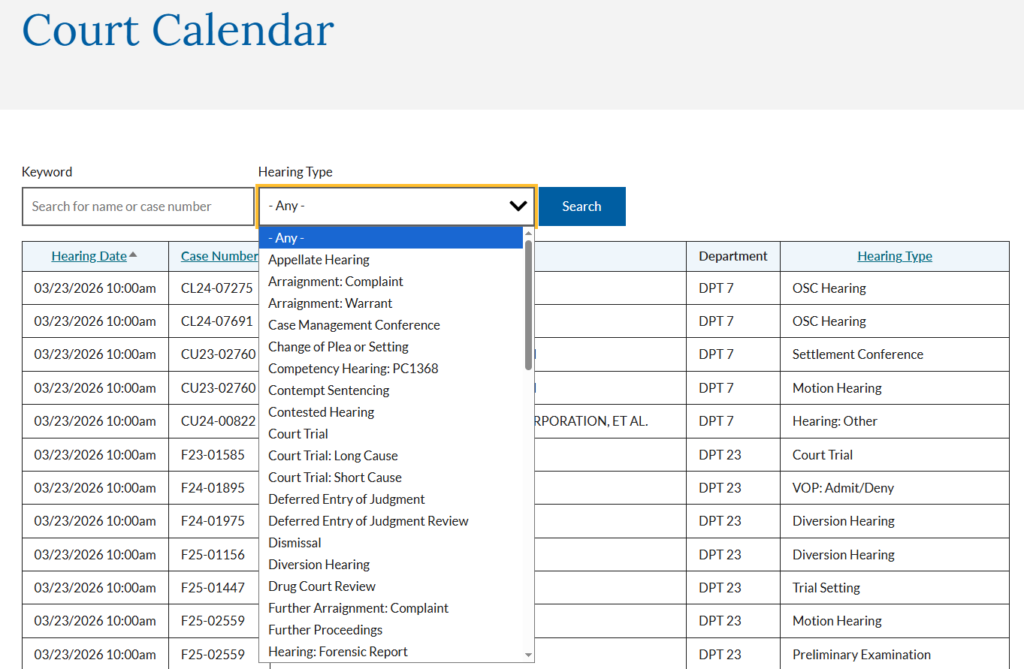
Users can apply different filters to locate hearings quickly and review the full trial calendar. This system supports accurate tracking of court proceedings and helps users stay aligned with official schedules. Follow the steps given below to search Court Calendar in Solano County Superior Court.
Direct Calendar Search URL: https://solano.courts.ca.gov/online-services/court-calendar
Open the Official Calendar Page
- Enter the direct URL in your browser
- The page loads the official court calendar search interface
- The screen displays search filters and a results section below
- The layout includes dropdown menus, a keyword field, and sorting options
Review Available Search Filters
The calendar page includes several fields that control how results appear. These filters help narrow down the court docket search results and improve accuracy. Each filter works together to refine the hearing date search and display only relevant records.
- Case Type: Select from Civil, Criminal, Family, Probate, or Traffic
- Hearing Type: Choose specific hearing categories such as motions or trials
- Keyword Field: Enter case number or party name
- Sorting Options: Arrange results based on case type or order
- Pagination Controls: Move through multiple result pages
Search by Case Number
The system retrieves the exact case entry from the court docket search database. The result shows detailed scheduling information linked directly to that case, including courtroom assignment and hearing type.
- Enter the complete case number in the keyword field
- Select the appropriate case type if known
- Leave other filters broad for better matching
- Click the search or apply filter option
Search by Party Name
The system scans records and displays matching entries. Each result connects to scheduled appearances listed under that name. Users can review multiple entries and identify the correct case using hearing type and department details.
- Enter the full or partial name of a plaintiff or defendant
- Use last name first for better results
- Keep filters open if unsure about case type
- Execute the search
Search by Hearing Date or Browse Calendar
The system loads a list of court sessions scheduled for the selected criteria. This view acts as a full trial calendar, showing multiple cases grouped by hearing type and department. Users can scroll through entries to review daily court activity.
- Leave the keyword field empty
- Select a case type or keep “All” for full listing
- Apply filters to display results
Analyze the Results Table
The results section presents structured docket listings in a table format. Each row represents a scheduled hearing. Users can scan rows to locate the correct case and confirm details linked to their case lookup. The table typically includes:
- Case Type
- Case Number
- Party Name
- Hearing Type
- Department or courtroom
- Scheduled hearing date
Apply Filters for Precision
These controls refine the court docket search and allow users to isolate exact records from large datasets.
- Adjust case type to limit results to a specific division
- Select a defined hearing type to narrow the list
- Use sorting controls to reorder entries
- Navigate across pages using pagination tools
Verify Hearing Details
- Match the case number with official records
- Confirm the party name listed in the results
- Note the assigned department or courtroom
- Record the exact hearing date and time
How the Solano County Court Calendar Works
The Solano county court calendar organizes court hearings, trials, and proceedings by date, department, and case type. It operates through a structured court docket system that tracks daily and future case schedules. The Solano county court calendar functions as a centralized judicial calendar that manages courtroom activity across all divisions. It arranges hearings by department, date, and time, allowing judges and staff to handle large volumes of cases efficiently. Each entry in the scheduling system includes case number, party details, hearing type, and assigned courtroom. This structured layout supports smooth case flow and helps users locate hearings quickly within the court docket system.
Calendar Structure and Organization
The calendar structure groups cases by department and hearing date to maintain an organized schedule. Each courtroom operates its own timeline within the broader solano county court calendar, which helps distribute workload evenly across departments. Cases appear in chronological order so court staff and visitors can follow daily proceedings without confusion. This format ensures consistent scheduling and improves clarity when reviewing multiple hearings listed in the court docket system.
- Department-based courtroom scheduling
- Chronological listing of hearings
- Clear labeling of hearing types
- Organized daily case flow
How Cases Are Listed in the Calendar
Cases are listed as individual entries within each department’s schedule in the judicial calendar. Each listing provides detailed information needed to identify and track the case throughout the legal process. The system updates regularly as new filings are added or hearing dates change. This approach keeps the court docket system accurate and ensures users can follow case progress and verify scheduled appearances using official records.
- Case number and category
- Party names involved in the case
- Hearing type such as trial or motion
- Assigned courtroom or department
- Scheduled date and time
Daily vs Long-Term Scheduling
The Solano county court calendar supports both daily and long-term scheduling within its scheduling system. Daily schedules display hearings set for a specific date, helping users track immediate court activity. Long-term scheduling shows future hearings, including trials and continued proceedings, allowing parties to plan ahead. This combination provides a complete view of case timelines and ensures all hearings remain organized alongside marriage and divorce records, making it easier to coordinate family law matters and related court actions.
- Daily calendar for same-day hearings
- Weekly or monthly future schedules
- Trial dates and continued hearings
- Ongoing updates to case timelines
Daily Court Sessions and Time Scheduling
Court sessions in Solano County Court follow a structured daily schedule with morning and afternoon hearings. These sessions use fixed time slots and department-based planning to manage daily hearings efficiently. The court organizes court sessions within standard operating hours of 8:00 AM to 5:00 PM, Monday through Friday, which apply across courthouse locations. Within this timeframe, hearings are divided into structured blocks to maintain a consistent courtroom schedule. Each case is assigned a specific time slot depending on its type and duration. This scheduling model supports smooth courtroom flow, reduces congestion, and helps judges manage large dockets across civil, criminal, and family divisions.
Morning Court Sessions
Morning court sessions usually begin around 8:30 AM, which is the most common start time for hearings across departments. Many criminal and civil calendars show 8:30 AM arraignments, motions, and status hearings scheduled at the start of the day. These early sessions handle high-volume matters that require shorter appearances or initial case review. Courts prioritize procedural hearings in the morning so that multiple cases can be processed efficiently within a limited time window.
- Typical start time: 8:30 AM
- Common hearings: arraignments, motions, status conferences
- Additional slots: 9:00 AM, 9:30 AM, 10:00 AM hearings
- Trials or extended hearings may begin late morning
Afternoon Court Sessions
Afternoon court sessions generally begin at 1:30 PM, which is a standard time block used across multiple departments for continued hearings and trials. These sessions are reserved for cases that require more time, including witness testimony, trials, and complex legal arguments. Some specialized hearings may also be scheduled later in the afternoon depending on department availability.
- Typical start time: 1:30 PM
- Extended hearings and trials
- Continued cases from morning sessions
- Additional specialized hearings in later slots (2:30 PM or later)
Time Slot Allocation
The court assigns time slots based on case complexity and hearing type. Standard scheduling patterns show multiple fixed time blocks throughout the day, allowing efficient distribution of daily hearings. For example, civil and criminal calendars include structured slots such as 8:30 AM, 9:00 AM, 10:00 AM, and 1:30 PM for different case categories. This system ensures that each case receives appropriate time without overlapping schedules.
- Short hearings: early morning slots (8:30–9:30 AM)
- Medium hearings: mid-morning slots (9:30–11:00 AM)
- Trials and complex matters: late morning or afternoon
- Afternoon blocks: typically start at 1:30 PM
Department-Based Scheduling
Each courtroom department follows its own courtroom schedule, which aligns with the overall system of court sessions. For example, criminal departments frequently schedule felony arraignments at 8:30 AM and jury trials at 10:00 AM or 1:30 PM, depending on case progress. Civil departments follow similar structured schedules with motion hearings, settlement conferences, and trials assigned to specific time slots throughout the day.
- Departments operate independent daily calendars
- Case types determine assigned time slots
- Judges manage schedules within their courtroom
- All departments follow the broader daily scheduling framework
Weekly and Monthly Hearing Dates in Solano County
Hearing dates Solano are organized through weekly and monthly court calendars that distribute cases across specific days and time blocks. These schedules include fixed hearing times such as 8:30 AM, 9:00 AM, 10:00 AM, and 1:30 PM, which help manage weekly hearings and future upcoming court dates. The system for hearing dates Solano uses a structured monthly calendar and weekly distribution to balance courtroom workload across departments. Courts schedule hearings in advance using fixed time slots and department calendars. Most hearings follow standard start times, with morning sessions beginning around 8:30 AM–9:00 AM and afternoon sessions starting at 1:30 PM. This scheduling framework allows consistent planning of upcoming court dates while ensuring that both short hearings and longer trials are spaced efficiently throughout the week and month.
Weekly Distribution of Hearings
Weekly scheduling spreads weekly hearings across Monday through Friday with consistent time blocks. Criminal and civil departments regularly begin hearings at 8:30 AM, followed by additional sessions at 9:00 AM, 9:30 AM, and 10:00 AM, depending on case type. This structure allows high-volume cases to be handled early in the day, while more detailed proceedings move into later time slots. Departments maintain consistent daily calendars, which keeps the courtroom schedule predictable across the week.
- Early morning hearings: 8:30 AM arraignments and motions
- Mid-morning sessions: 9:00 AM–10:00 AM hearings and trials
- Afternoon continuation: 1:30 PM hearings and trials
- Some specialized hearings extend to 2:30 PM or later in select departments
Monthly Scheduling Trends
The monthly calendar shows how hearing dates Solano are distributed over several weeks using repeating time patterns. Many hearings are scheduled weeks in advance using fixed slots such as 9:00 AM conferences, 10:00 AM trials, and 1:30 PM continued hearings. Courts often assign recurring hearing types to specific days of the month, such as settlement conferences or case management hearings. This consistent pattern helps maintain balance across departments and allows parties to track upcoming court dates over longer periods.
- Hearings scheduled several weeks ahead
- Repeated time slots used across the month
- Trials commonly set at 10:00 AM or 1:30 PM
- Monthly cycles include recurring hearings and follow-ups
Long-Term Planning and Visibility
The court calendar provides long-term visibility into hearing dates Solano, allowing users to track case timelines across months. Future hearings, including trials and case management conferences, are scheduled using standard time blocks such as morning sessions (8:30–11:00 AM) and afternoon sessions (1:30 PM onward). This structured planning allows attorneys and parties to prepare in advance and follow case progress without confusion. The consistent use of recurring time slots ensures clarity and supports efficient coordination across all departments.
- Future hearings scheduled months in advance
- Standard time blocks used for all case types
- Clear visibility of trial and conference dates
- Ongoing updates reflected in the monthly calendar
Locations for Hearings & Court Calendar
Solano county court locations include multiple courthouse facilities across Solano County where hearings are conducted. These hearing venues are assigned based on case type, ensuring cases are handled at the correct court branch. The Solano county court locations system is organized across several court branches that handle criminal, civil, family, probate, and traffic matters. Each courthouse serves a specific role within the county, and hearings are scheduled at designated locations. Knowing the correct courthouse address and contact details helps parties attend hearings on time and reach the correct department without confusion.
Fairfield Court Facility
The Fairfield courthouse is the main administrative center and primary location for criminal cases and jury services. It handles high-volume court sessions and serves as the central hub for court operations in Solano County.
- Address: 600 Union Avenue, Fairfield, CA 94533
- Phone: (707) 207-7300
- Hours: Monday–Friday, 8:00 AM – 5:00 PM
- Departments: Criminal, Jury Services, Administration
Vallejo Court Facility
The Vallejo courthouse handles civil, family law, probate, and small claims cases. It serves the southern part of Solano County and includes multiple specialized departments for non-criminal matters.
- Address: 321 Tuolumne Street, Vallejo, CA 94590
- Phone: (707) 561-7800
- Hours: Monday–Friday, 8:00 AM – 5:00 PM
- Departments: Civil, Family Law, Probate, Small Claims
Vacaville Court Facility
The Vacaville courthouse provides services for traffic and limited civil cases. It also offers clerk services for filings and record requests for residents in the northern region of the county.
- Address: 600 Union Avenue, Fairfield, CA 94533 (Some Vacaville services are administered through Fairfield; confirm department before visiting)
- Phone: (707) 207-7300
- Hours: Monday–Friday, 8:00 AM – 5:00 PM
- Departments: Traffic, Limited Civil, Clerk Services
Directions and Accessibility
- Located near Interstate 80 for easy travel between cities
- Public transportation available in Fairfield, Vallejo, and Vacaville
- Wheelchair-accessible entrances and elevators at all locations
- Parking facilities available near courthouse buildings
Frequently Asked Questions
The Solano county court calendar FAQs answers common questions about court schedules, hearing dates, and calendar searches. It helps users understand how to read the calendar and track case updates. Many users rely on this information for hearing date questions and accurate court schedule help. This section provides clear answers to help users stay informed about upcoming court dates and avoid missing scheduled appearances.
How to check a hearing date?
A person can check a hearing date through the official Solano county court calendar search page. The system allows a search using case number, party name, or by browsing daily schedules. After entering the required details, the results show daily hearings with time, department, and case information. Users should carefully match the case number and party name to confirm accuracy. This process provides reliable court schedule help and helps users verify their hearing dates Solano before attending court or preparing documents.
What time do hearings start?
Court hearings follow a structured courtroom schedule with fixed time blocks. Most morning court sessions begin around 8:30 AM or 9:00 AM, while afternoon sessions usually start at 1:30 PM. Some departments may include additional slots such as 10:00 AM or later afternoon hearings. The exact timing depends on the case type and assigned courtroom. Users should always check the official listing for their case to confirm the correct time. This helps avoid delays and supports better planning for daily hearings.
Can a search be done without a case number?
Yes, the calendar system allows users to perform a case lookup without a case number. A person can search using a party name or browse hearings by date. This option is helpful for general hearing date questions or when limited case details are available. The system may show multiple results, so users should review entries carefully and match details such as case type or department. This method still provides useful court schedule help and helps locate upcoming court dates effectively.
Why is a case not visible?
Some cases may not appear in the court docket system due to privacy restrictions or system updates. Certain matters, such as juvenile or confidential cases, are not available to the public. In other situations, newly filed cases or recent changes may take time to reflect on the judicial calendar. If a case cannot be found, users may contact the clerk’s office for assistance. This ensures proper court schedule help and allows confirmation of hearing dates Solano through official channels.
How often is the calendar updated?
The Solano county court calendar is updated regularly throughout the day as courts adjust schedules. Changes may include new hearings, rescheduled appearances, or completed cases. These updates help keep the court sessions accurate and reflect current case activity. Users should check the calendar more than once, especially before a scheduled hearing, to confirm details. Frequent updates provide reliable court schedule help and ensure that all upcoming court dates are displayed correctly for users and court staff.
What to do if a hearing date changes?
If a hearing date changes, the updated schedule will appear on the court calendar. Users should review the new date, time, and department listed in the system. In some cases, official notices may be sent to involved parties with updated details. It is important to confirm the revised information before attending court. Checking the calendar regularly provides consistent court schedule help and reduces the chance of missing a scheduled appearance or arriving at the wrong time for a hearing.